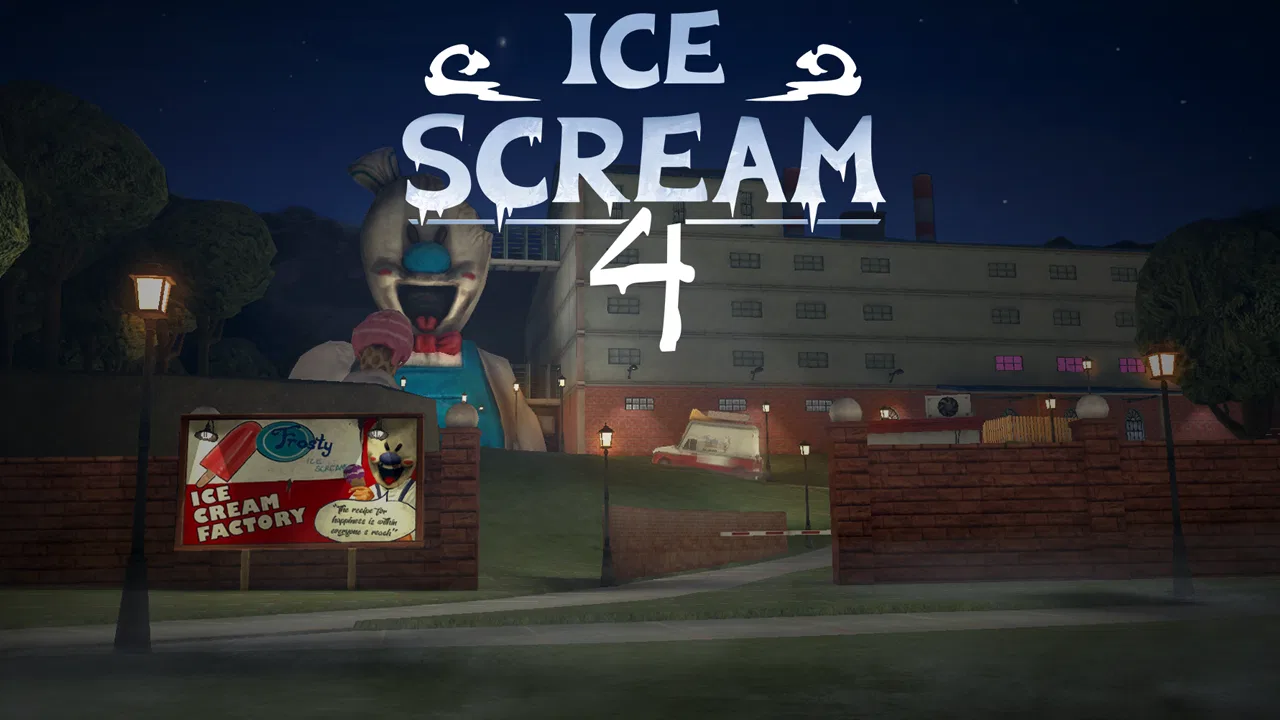
Ice Scream 4: Rod's Factory
- 4.2
- Rating
- 10.00M
- Installs
- Free
- Price

 Analysis by App-foxy
Ice Scream 4: Rod's Factory is the kind of adventure game that makes a strong first impression because it gives me a clear reason to keep moving: enter Rod’s factory, understand what is happening, and find a way through a hostile place without being caught. I played it as a tense hide-and-search experience rather than a fast action game, and that distinction matters. The fun comes from noticing details, choosing when to take a risk, and learning how the factory behaves.
Developed by Keplerians Horror Games, it is free to download and aimed at Teen players. The game has reached over ten million installs and holds a 4.2 average from roughly 151 thousand ratings, which fits my impression that it has a broad audience but is not trying to be a premium, cinematic console-style horror adventure. Its current version is 1.3.274, and it runs on Android 7.0 or later. Optional purchases range from $1.49 to $2.99 per item.
What the first week feels like
My first sessions were driven by curiosity more than comfort. The factory setting gives the game a useful sense of direction: I am not wandering through an abstract maze with no purpose. Rooms, corridors, objects, and locked routes all feel connected to the central mystery. The best moments arrive when I find a clue that changes how I understand an earlier area, or when a familiar route suddenly becomes dangerous because I am being pursued.
You May Also Like

 Blood Strike: 2.5 Anniversary
Blood Strike’s Loadouts Turn Every Drop Into a Tactical Gamble
A close look at Blood Strike’s custom loadouts: how fast access to signature weapons reshapes its battle royale rhythm, rewards preparation, and narrows the gap between fights.

 Pandora - Music & Podcasts
Pandora’s Music Is Easy to Start, but Harder to Recover
Pandora’s strength is its low-effort path from a seed to a station. Its weak spot is how much confidence it asks you to place in connection, setup, and quiet recovery.

 8 Ball Pool
 Is Built on Rivalries, Rematches, and Routine
A close look at the rivalries, rematches, shared routines, and unanswered safety questions that turn a quick pool match into a persistent mobile community.

 Samsung Music
’s Quiet Strength Is Playing What You Already Own
Its reach comes less from spectacle than from dependable access to a personal library. That simplicity is both the app’s strongest retention engine and its ceiling.

 AccuWeather: Weather Radar
AccuWeather Review: A Quick, Clear Forecast for Everyday Decisions
For everyday plans, the best forecast is the one you can understand quickly. AccuWeather makes rain timing, radar, and local conditions easy to act on, with a few trade-offs.

 Hill Climb Racing
Why Hill Climb Racing Still Turns Crashes Into One More Run
A tiny car, a bumpy hill and one more upgrade: Hill Climb Racing keeps resurfacing because its simple chaos makes every near-miss feel personal.
More From Our News Desk
View All News


The game works especially well in short sessions. I can play for a little while, stop after solving part of a route, and return later with a clearer idea of what I want to test. That makes it suitable for a commute, a break, or an evening when I want tension without committing to a long story campaign. I would not describe it as relaxing, though. Even when the controls are simple, the need to listen, observe, and react keeps the experience mentally active.
The opening appeal also comes from the balance between exploration and threat. If the game were only about collecting objects, the factory would feel like a puzzle box. If it were only about escaping an enemy, the puzzles would become interruptions. Here, the two sides support each other. I often had to decide whether an item was worth picking up immediately, whether a route was safe enough to investigate, and whether I had remembered the layout correctly.
A useful early habit is to treat every room as part of a route rather than as a separate challenge. I paid attention to entrances, hiding opportunities, blocked passages, and places where an object might become useful later. That approach reduced backtracking and made failed attempts more informative. Instead of thinking, “I lost, so I must start over,” I could think, “Now I know which path is risky and which clue I ignored.”
The strongest early lesson is that patience is more valuable than speed. Rushing through the factory usually created more problems than it solved. I had better results when I paused to understand my surroundings before moving an item or crossing an exposed area. Players who enjoy stealthy problem-solving will probably connect with this quickly; players looking for constant combat may wonder why the game feels deliberately restrained.
How the factory turns observation into progress
The setting is not simply decoration. The factory gives the puzzles a practical context, so I was encouraged to inspect spaces as if they had a purpose. That makes small environmental details more important than they might appear at first. A door, a machine, a narrow passage, or a misplaced object can become relevant after I discover a new objective.
This design creates a satisfying loop: explore, notice something unusual, search for a way to use it, then return with better knowledge. It also means that the game rewards memory. I found it helpful to remember landmarks instead of trying to memorize every corridor. On a phone screen, that is a realistic strategy because writing down every detail would interrupt the atmosphere.
One practical tip is to avoid using an item just because the game allows interaction with it. I learned to ask what the action changes. Does it open a route, create a distraction, reveal information, or merely confirm that the object is part of the environment? That small pause helped me avoid wasting time and made the puzzles feel less random.
The first week is where the novelty is at its highest. The factory feels unfamiliar, Rod’s presence creates pressure, and each discovery seems to promise a larger explanation. The question is whether the game can remain worthwhile once I know the main routes and the surprise of the setting has faded.
What remains after the novelty wears off
After the initial excitement, the value of Ice Scream 4 depends heavily on how much I enjoy replaying a tension-based puzzle adventure. Its lasting appeal is not the same as that of a competitive game, a daily progression app, or a large role-playing game. I do not return because I need to maintain a character or complete an endless stream of new activities. I return when I want the particular feeling of navigating danger while trying to solve a contained mystery.
That makes the game a good occasional choice rather than an automatic daily habit. I can imagine recommending it to a friend who likes horror games but prefers puzzles and exploration over graphic violence. I would also suggest it to someone who enjoys learning an environment through repeated attempts. The factory becomes easier to read with experience, and that growing familiarity can be satisfying in its own way.
At the same time, the month-to-month value is limited if I need constant novelty. Once I understand the important routes and the basic rhythm of pursuit, some tension naturally disappears. A scare is most effective when I do not know what is around the corner. Replaying the same sequence can turn that uncertainty into routine, especially for players who solve environmental puzzles quickly.
My advice is to avoid treating it like a game that must be played every day. A short break can help preserve its atmosphere. If I return after some time away, the factory feels less automatic, and I am more likely to notice details I had forgotten. This is one of the few cases where not forcing a daily routine improves the experience.
The free entry point also helps with that occasional role. I can try the core experience without first committing money, then decide whether the game deserves more of my time. The optional purchases are priced between $1.49 and $2.99 per item, so they are not the main reason to install it, but I would still recommend deciding in advance whether I want to spend anything. A tense game can become less enjoyable if I start thinking about purchases instead of the next puzzle.
Who gets the most recurring value
For me, the best long-term audience is someone who likes revisiting a known location with a different mindset. On a first run, I focus on survival and discovery. Later, I can focus on efficiency, cleaner routes, or understanding why a previous attempt failed. That is not an unlimited source of replayability, but it gives the game more depth than a one-time jump-scare experience.
It is also useful for players who want a horror game that can be played in manageable pieces. I would choose it over a long open-world adventure when I have limited time and want a clear objective. The factory’s contained structure gives each session a sense of purpose, even if I only make one meaningful discovery.
I would skip it if I dislike being chased, repeating sections after mistakes, or searching for the correct interaction without much guidance. I would also look elsewhere if I want a story-heavy experience with extensive dialogue, character development, or a large world that keeps expanding. This game’s strengths are concentration, atmosphere, and route learning, not breadth.
Maintenance, friction, and the cost of staying engaged
There is little maintenance in the usual sense because this is not a game built around daily tasks, resource timers, or a character that needs regular attention. That is a positive for me. I can leave it installed without feeling that I am falling behind. Its current version, 1.3.274, gives Android players a clear compatibility point, and the minimum requirement of Android 7.0 makes it accessible on a wide range of devices that are not brand new.
The real maintenance burden is mental. I need to remember what I have already tried, where a route leads, and which object may become useful later. If I stop playing for several weeks, I may spend the first session reconstructing my plan. That is not a technical problem, but it affects the ease of returning. The game benefits from keeping a simple mental note before quitting, such as the last objective or the area that still needs investigation.
Another friction point is the way tension can make small mistakes feel expensive. A missed turn or poorly timed interaction may force me to repeat part of the process. That can be exciting when I am learning, but tiring when I already understand the solution. The trade-off is clear: repetition builds mastery, yet too much repetition can make the game feel slower than it did during the first sessions.
I also found that the best way to play is with enough attention to hear and observe what is happening. This is not a good background game for watching another video or answering messages. Splitting my attention made the factory feel confusing, and I missed useful cues. In everyday terms, it is better suited to a focused ten-minute break than to half-playing while doing something else.
My practical maintenance tip is to stop after a discovery, not after a frustrating failure. Ending on a useful clue makes it easier to return. If I quit immediately after being caught, I remember the irritation more than the progress. That small change helped me preserve the game’s appeal over multiple sessions.
Where fatigue begins
The main source of fatigue is repetition without a fresh question. Early on, every locked area suggests a new possibility. Later, if I already know the likely solution but must repeat the same route to reach it, the suspense weakens. The game remains playable, but the emotional payoff becomes smaller.
Another possible issue is the narrowness of its appeal. Horror fans who want atmosphere and pursuit may find the pacing effective. Players who prefer direct control, fast movement, or frequent action may find the same pacing slow. That is not a flaw that can be solved by playing better; it is a matter of taste built into the design.
The Teen rating is also worth considering before recommending it to younger players. The game’s frightening situations and pursuit-focused atmosphere are central to the experience, so I would not choose it for someone who is easily unsettled by horror themes. A parent should judge that fit personally rather than assuming that a mobile format makes the game mild.
Compared with a typical action adventure, this one asks me to be cautious instead of powerful. Compared with a pure puzzle game, it adds pressure that can make simple decisions feel urgent. Compared with an endless horror game, it has a more defined setting and objective, but less reason to return indefinitely. Those trade-offs explain both its appeal and its limits.
My long-term verdict
Ice Scream 4: Rod's Factory earns a place on my phone if I want a free adventure game built around exploration, stealthy tension, and environmental problem-solving. Keplerians Horror Games has created an experience that is easy to sample but more rewarding when I slow down and learn the factory instead of treating every problem as a race.
I would recommend installing it for a focused first-week experience, especially if you enjoy being chased while you search for clues and routes. I would not promise endless monthly content or unlimited replay value. Its lasting strength is more modest and more specific: it remains a useful game to revisit when I want a compact horror challenge that does not demand a daily commitment.
The free price makes that decision straightforward, while the optional purchases give players a choice rather than making the entry barrier the main story. With over ten million installs, a 4.2 average, and a Teen rating, it has clearly found a sizable audience, but popularity does not change the central question: do you enjoy learning a dangerous place through repeated attempts?
My answer is yes, with a condition. I would keep it installed for occasional sessions, not as my main mobile game. When the factory is still unfamiliar, it creates real suspense and satisfying discoveries. When the routes become routine, I would take a break rather than force myself through repetition. It earns lasting space as an on-and-off horror adventure, not as an endless habit.
FAQs for Ice Scream 4: Rod's Factory
01What is the main objective of Ice Scream 4: Rod's Factory?
In Ice Scream 4: Rod's Factory, players aim to rescue friends who have been captured by the evil ice cream vendor, Rod. The game combines stealth and puzzle-solving as you navigate through the factory, avoiding Rod and his minions, while strategically solving puzzles to advance and free your friends.
02Is Ice Scream 4: Rod's Factory suitable for all age groups?
Ice Scream 4 is designed primarily for teens and above due to its horror elements and suspenseful gameplay. While not overly graphic, it contains tense situations that might not be suitable for younger children. Parental discretion is advised for younger players interested in the game.
03Can Ice Scream 4: Rod's Factory be played offline?
Yes, Ice Scream 4: Rod's Factory can be played offline. This makes it a great option for users who want to enjoy the game without a constant internet connection, ensuring that you can continue your adventure and solve puzzles anytime, anywhere.
04What are the system requirements for Ice Scream 4 on Android and iOS?
Ice Scream 4 requires iOS 10.0 or later for Apple devices and Android 4.4 or higher for Android devices. It's recommended to have at least 2GB of RAM for smooth gameplay. Ensure your device meets these requirements to enjoy the game without performance issues.
05Are there in-app purchases in Ice Scream 4: Rod's Factory?
Yes, Ice Scream 4 includes in-app purchases. Players can buy hints or other helpful items to enhance their gameplay experience. While the entire game can be completed without purchases, these options are available for those seeking extra assistance or to enhance their gaming experience.
Pros
- Engaging storyline with intriguing twists.
- Challenging puzzles that enhance gameplay.
- Impressive graphics for an immersive experience.
- Smooth controls for seamless navigation.
- Regular updates with new features and fixes.
Cons
- Some puzzles can be overly complex.
- In-app purchases may be necessary.
- Occasional lag on older devices.
- Lack of hints can frustrate new players.
- Ads can interrupt gameplay frequently.

Ice Scream 4: Rod's Factory
Gallery